 |
|
||||||||||||
|
Institute of Philology of
the Siberian Branch of Russian Academy of Sciences |
|
||||||||||||
|
|||||||||||||


 | |
| Sibirskii Filologicheskii Zhurnal (Siberian Journal of Philology) | |
| |
|
Article
Authors: Andrey V. Sharavin, Irina L. Startseva, Yaroslav O. Rezakov Bryansk State Academician I. G. Petrovski University, Bryansk, Russian Federation In the section Study of literature
Abstract: This paper analyzes the specific nature of A. Tolstoy’s speech regarding L. Dobychin, interpreting it as a complex statement built upon diverse and contradictory meanings. On a literal level, Tolstoy’s report advocates for the re-education of aspiring writers who had lost touch with Soviet reality. However, the contextual and subtextual information embedded in his speech reveals a different thesis: the detachment of the “county writer” from Soviet life is rationalized as an adherence to the literary traditions of Marcel Proust and James Joyce, purportedly instilled in the young author by his mentors, primarily Konstantin Fedin. Furthermore, the study examines Tolstoy’s speech as a direct reaction to H. G. Wells’s 1934 visit to the USSR, during which the English writer met with Joseph Stalin, Maxim Gorky, and various literary figures in Moscow and Leningrad. The content and rhetorical form of Tolstoy’s address suggest that its historical and literary context was heavily influenced by Wells’s intention to recruit Soviet cultural figures into the PEN Club. Wells’s recollection that Tolstoy had kindly agreed to this proposal fundamentally predetermined the defensive subtext of Tolstoy’s speech. By accusing Fedin and Dobychin of sympathizing with unreliable foreign authors, Tolstoy employed a manipulative strategy marked by semantic ambiguity. This approach allowed him to distance himself from accusations of orchestrating a reprisal against Dobychin, deflect suspicion regarding his own contacts with questionable foreign figures, and cultivate the public image of a staunch defender of ideological purity within Soviet literature. Keywords: formalism, European/Soviet literature, PEN Club, L. Dobychin, A. Tolstoy, H. G. Wells Bibliography: Bakhtin V. S. Sud’ba pisatelya L. Dobychina [The fate of the writer L. Dobychin]. Zvezda. 1989, no. 9, pp. 177–182. Kaverin V. A. Epilog [Epilogue]. Moscow, Vagrius, 2006, 571 p. Meshkov V. A. Pisatel’-zagadka Leonid Dobychin: krymskiye stranitsy [Mystery writer Leonid Dobychin: Crimean pages]. Simferopol, Tavrida, 2015, 224 p. Mishkevich G. Tri chasa u velikogo fantasta [Three hours with the great science fiction writer]. In Vtorzheniye v Persey [The invasion of Perseus]. Leningrad, Lenizdat, 1968, pp. 435–442. Nikulin L. Lyudi i stranstviya. Vospominaniya i vstrechi [People and wanderings. Memories and meetings]. Moscow, Sov. pisatel’, 1962, 512 p. Pisatel’ Leonid Dobychin: vospominaniya, stat’i, pis’ma: sbornik [Writer Leonid Dobychin: memoirs, articles, letters: collection]. St. Petersburg, Zvezda, 1995, 304 p. |


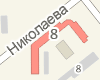 |
Institute of Philology Nikolaeva st., 8, Novosibirsk, 630090, Russian Federation +7-383-330-15-18, ifl@philology.nsc.ru |
© Institute of Philology |