 |
|
||||||||||||
|
Institute of Philology of
the Siberian Branch of Russian Academy of Sciences |
|
||||||||||||
|
|||||||||||||


 | |
DOI: 10.25205/2307-1737 Roskomnadzor certificate number Эл № ФС 77-84784 | |
| Kritika i Semiotika (Critique and Semiotics) | |
| |
|
Article
Authors: Sergey V. Sannikov Russian Presidential Academy of National Economy and Public Administration, Moscow, Russian Federation
Abstract: The article examines the problem of representation of power relations in discourse using historical material. The approach developed within the framework of the critical discourse analysis (T. van Dijk, R. Wodak, A. Holzscheiter, and N. Fairclough) is revised and expanded using the methods of the Russian and the German semiotic schools, particularly the concept of representation of power in culture by R. Posner and M. Siefkes and the semiotics of culture by Yu. M. Lotman. Power is considered in the context of semiotic relations in three dimensions of culture: mental culture, social culture, and material culture, which correspond to three types of power: the power of interpretation, manifested in various spheres of intellectual and religious culture; the power of disposition, mainly related to property; and hierarchical power (the power of position), implemented through institutions. Keywords: analysis of discourse, semiotics of culture, image of power, symbolic power, medieval culture, Jordanes, Gregory of Tours, Alfred the Great Bibliography: Barthes R. Diskurs istorii [Discourse of history]. In: Bart R. Sistema mody. Stat’i po semiotike kul’tury [The fashion system. Essays on the semiotics of culture]. Moscow, Izd-vo im. Sabashnikovykh, 2003. 511 p. Pp. 427–441. (in Russ.) Barthes R., Howard R. Lecture in inauguration of the chair of literary semiology, Collège de France, January 7, 1977. October, 1979, vol. 8, pp. 3–16. Dijk, van T. A. Diskurs i vlast’: reprezentatsiya dominirovaniya v yazyke i kommunikatsii [Discourse and power: representation of dominance in language and communication]. Moscow, URSS, 2013. 344 p. (in Russ.) Dijk, van T. A. Discourse, power and access. In: Texts and practices: readings in critical discourse analysis. Ed. by Carmen Rosa Caldas-Coulthard and Malcolm Coulthard. London, New York, Routledge, 1996. 312 p. Pp. 84–104. Fairclough N. Language and power. London, Longman, 1989. XII, 259 p. Foucault M. L’Ordre du discours. Leçon inaugurale au Collège de France prononcée le 2 décembre 1970. Paris, Gallimard, 1971. 81 p. Gramcsi A. Tyuremnyye tetradi [Prison notebooks]. V 4 ch. Ch. 1. Moscow, Politizdat, 1991. 559, [1] p. (in Russ.) Holzscheiter A. Power of discourse and power in discourse: an investigation of transformation and exclusion in the global discourse of childhood. Unpublished PhD thesis, Freie Universität Berlin, 2005. Jaspers K. Smysl i naznachenie istorii [The origin and goal of history]. Moscow, Politizdat, 1991. 527, [1] p. (in Russ.) Laclau E., Mouffe C. Hegemony and socialist strategy: towards a radical democratic politics. London, 1985. XIX, 198 p. Lotman Yu. M. Kul’tura i vzryv [Culture and explosion]. Moscow, Progress, Gnosis, 1992. 270, [1] p. (in Russ.) Lotman Yu. M. Problema znaka i znakovoy sistemy i tipologiya russkoy kul’tury XI–XIX vekov [The problem of the sign and the sign system and the typology of Russian culture of the 11th–19th centuries]. In: Stat’i po tipologii kul’tury [Essays on the typology of culture]. Tartu, 1970. 105 p. (in Russ.) Mandoki K. Power and semiosis. Semiotica, 2004, vol. 151 (1/4), pp. 97–114. Pêcheux M. Chto znachit chitat’ arkhivnyy dokument segodnya? [What does it mean to read an archival document today?]. In: Kvadratura smysla. Frantsuzskaya shkola analiza diskursa [The quadrature of meaning: the French school of discourse analysis]. Moscow, Progress, 1999. 416 p. (in Russ.) Posner R. Basic tasks of cultural semiotics. In: Signs of power — power of signs: essays in honor of Jeff Bernard. Ed. by Gloria Withalm and Josef Wall-mannsberger. Vienna, INST, 2004. 536 p. Pp. 56–89. Potseluyev S. P. «Simvolicheskaya politika»: k istorii kontsepta [“Symbolic politics”: towards the history of the concept]. In: Simvolicheskaya politika [Symbolic politics]. Ed. by O. Yu. Malinova. Moscow, INION RAN, 2012. Vyp. 1: Konstruirovaniye predstavleniy o proshlom kak vlastnyy resurs [Iss. 1: Constructing ideas about the past as a power resource]. 333 p. Pp. 17–53. (in Russ.) Proskurin S. G., Proskurina A. V. Kul’turnyye transfery i teksty [Cultural transfers and texts]. Novosibirsk, IPTS NGU, 2017. 173, [2] p. (in Russ.) Siefkes M. Power in society, economy, and mentality: towards a semiotic theory of power. Semiotica, 2010, vol. 181 (1/4), pp. 225–261. Silant’yev I. V. Diskurs i zhanr [Discourse and genre]. Vestnik NGU. Seriya: Istoriya, filologiya. Tom 9: Zhurnalistika [Novosibirsk State University Bulletin. Series: History and Philology. Vol. 8: Journalism], 2010, no. 6, pp. 78–83. (in Russ.) Tell D. Review: The sacrament of language: an archaeology of the oath by Giorgio Agamben and Adam Kotsko. Philosophy & Rhetoric, 2012, vol. 45, no. 4, pp. 452–459. Weber M. Wirtschaft und gesellschaft. In 2 Bden. Bd. 2. Tübingen, Mohr, 1956 (1922). XVIII, 1033 S. S. 181–876. Wodak R. Language, power and identity. Language Teaching, 2012, vol. 45, no. 2, pp. 215–233. |

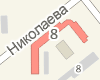 |
Institute of Philology Nikolaeva st., 8, Novosibirsk, 630090, Russian Federation +7-383-330-15-18, ifl@philology.nsc.ru |
© Institute of Philology |