 |
|
||||||||||||
|
Institute of Philology of
the Siberian Branch of Russian Academy of Sciences |
|
||||||||||||
|
|||||||||||||


 | |
DOI: 10.25205/2307-1737 Roskomnadzor certificate number Эл № ФС 77-84784 | |
| Kritika i Semiotika (Critique and Semiotics) | |
| |
|
Article
Authors: Marina V. Shpilman Novosibirsk State Pedagogical University, Novosibirsk, Russian Federation
Abstract: The article considers imitation of the linguistic leader of a small social group as a necessary stage in the development of linguistic creativity of a linguistic personality. Using the example of contexts from fiction demonstrating imitation of different language leaders, in addition to the main properties common to them — charisma and creative use of language, additional factors of linguistic leadership have been identified: the duration of the leader’s “speech pressure” on a group member and the possibility of using a borrowed word outside the group. It has been revealed that imitation at different ages has its own specifics; it can be unconscious and conscious, partial or close to exact copying. Keywords: imitation, everyday imitation, leader, linguistic leader, linguistic personality, linguistic creativity, linguistic worldview Bibliography: Anohina V. S. Rechevoe liderstvo v sem’e: kriterii vydeleniya i sredstva vyrazheniya [Speech leadership in the family: selection criteria and means of expression]. East European Scientific Journal, 2017, no. 802 (24), pp. 40–43. (in Russ.) Bajkulova A. N. Rechevoe obshchenie v sem’e [Speech communication in the family]. The abstract of Cand. of Sci. (Philol.) diss. Saratov, 2006. 20 p. (in Russ.) Chujkina E. A. Osvoenie novogo slova: samorefleksiya govoryashchego sub”ekta [Mastering a new word: self-reflection of the speaking subject]. Siberian Philological Journal, 2008, no. 4, pp. 205–209. (in Russ.) Gnatko N. M. Problemy kreativnosti i yavlenie podrazhaniya [Problems of creativity and the phenomenon of imitation]. Мoskow, IP RAN, 1994. 117 p. (in Russ.) Kazakova T. A. Hudozhestvennyj perevod: v poiskah istiny [Artistic translation: in search of the truth]. Saint Petersburg, Izdatel’stvo Sankt-Peterburgskogo un-ta, 2006, 224 p. (in Russ.) Krysin L. P. O rechevom povedenii cheloveka v malyh social’nyh obshchnostyah (postanovka voprosa) [On human speech behavior in small social communities (raising the question)]. In: Yazyk i lichnost’ [Language and personality]. Ed. by D. N. Shmelev. Мoskow, Nauka, 1989. Pp. 78–86. (in Russ.) Krysin L. P. Russkoe slovo, svoe i chuzhoe: issledovaniya po sovremennomu russkomu yazyku i sociolingvistike [The Russian word, one’s own and somebody else’s: research on the modern Russian language and sociolinguistics]. Мosсow, Yazyki slavyanskoj kul’tury, 2004, 888 p. (in Russ.) Milekhina T. A. Kommunikativnyj lider: shtrihi k rechevomu portretu [The communicative leader: touches to a speech portrait]. In: Problems of speech communication: inter-university collection of scientific papers. Issue 18. Book II. Saratov, Saratovskij nacional’nyj issledovatel’skij gosudarstvennyj universitet imeni N. G. Chernyshevskogo, 2018, pp. 77–90. (in Russ.) Poetika: slovar’ aktual’nyh terminov i ponyatij [Poetics: dictionary of current terms and concepts]. Ed. by N. D. Tamarchenko. Moscow, Izdatel’stvo Kulaginoj; Intrada, 2008. 358 p. (in Russ.) Sirotinina O. B. Harakteristika tipov rechevoj kul’tury v sfere dejstviya literaturnogo yazyka [Characteristics of types of speech culture in the sphere of literary language]. In: Problems of speech communication: inter-university collection of scientific papers. Ed. by M. A. Kormilicyna. Saratov, Izd-vo Sarat. un-ta, 2003. Issue 2. Pp. 3–20. (in Russ.) Slovar’ russkogo yazyka [Dictionary of the Russian language]. In 4 vols. Ed. by A. P. Evgeneva. Moscow, Russkii yazyk, 1981–1984. URL: http://feb-web.ru/feb/mas/mas-abc/default.asp (accessed 14.11.20025). (in Russ.) Verbickaya M. V. Teoriya vtorichnyh tekstov [The theory of secondary texts]. The abstract of Doct. of Sci. (Philol.) diss. Мoscow, 2000. 48 p. (in Russ.) Zanadvorova A. V. Otrazhenie social’noj differenciacii yazyka v yazykovoj zhizni malyh social’nyh grupp (na primere sem’i) [Reflection of social differentiation of language in the linguistic life of small social groups (on the example of the family)]. In: Sovremennyj russkij yazyk: social’naya i funkcional’naya differenciaciya [Modern Russian language: social and functional differentiation]. Ed. by L. P. Krysin. Мoscow, Yazyki slavyanskoj kul’tury, 2003. Pp. 277–340. (in Russ.) |

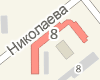 |
Institute of Philology Nikolaeva st., 8, Novosibirsk, 630090, Russian Federation +7-383-330-15-18, ifl@philology.nsc.ru |
© Institute of Philology |