 |
|
||||||||||||
|
Institute of Philology of
the Siberian Branch of Russian Academy of Sciences |
|
||||||||||||
|
|||||||||||||


 | |
DOI: 10.25205/2307-1737 Roskomnadzor certificate number Эл № ФС 77-84784 | |
| Kritika i Semiotika (Critique and Semiotics) | |
| |
|
Article
Authors: Chang, Jui-Cheng National Chengchi University, Taipei, Taiwan
Abstract: The article analyzes the metaphor of PATH in Boris Yeltsin’s farewell New Year’s Address (1999) and the peculiarities of its translation into Chinese. The aim of the study is to identify the structure and functions of the metaphorical model “THE DEVELOPMENT OF A COUNTRY is A PATH” in the address and to analyze the specific features of its interpretation in the translation into Chinese. The methodological framework of the study is based on cognitive, semantic, and pragmatic analysis of linguistic units, as well as a comparative analysis of the target text and the source text. The author characterized the frames and the slots of the model. The analysis reveals that Boris Yeltsin employs this metaphor to evaluate the economic reforms in Russia in the 1990s, justifies the necessity of the transfer of power, and charts the vector for the country’s future development. The comparative analysis shows that the translator predominantly used the strategy of preserving metaphorical images, which is facilitated by the presence of similar mapping conditions in Russian and Chinese. The preservation of the model’s frame-slot structure ensures an equivalent pragmatic effect for the target audience. The findings can be applied in courses of cognitive linguistics, political discourse, and theory of translation. Keywords: political discourse, New Year’s address, conceptual metaphor, sphere source, frames, slots, translation Bibliography: Arutjunova N. D. Metafora i diskurs [Metaphor and discourse]. In: Teorija metafory: sbornik [Theory of metaphor: edited volume] / ed. by N. D. Arutjunova and M. A. Zhurinskaya. Moscow, Progress, 1990. Pp. 5–32. (in Russ.) Baranov A. N. Deskriptornaja teorija metafory [Descriptor theory of metaphor]. Moscow, 2014. 632 p. (in Russ.) Baranov A. N. Vvedenie v prikladnuju lingvistiku [An introduction to Applied Linguistics]. Moscow, 2001. 347 p. (in Russ.) BAS — Slovar’ sovremennogo russkogo literaturnogo jazyka: v 17 t. [A dictionary of modern Russian literary language: in 17 vols]. Moscow; Leningrad, 1948–1965. (in Russ.) Chang, Jui-Cheng. Analiz metafory puti v politicheskom diskurse (na materiale Poslanija V. V. Putina Federal’nomu Sobraniju 2023 g.) [An analysis of the way metaphor in political discourse (On the material of V. V. Putin’s 2023 Presidential Address to the Federal Assembly)]. Political Linguistics, 2024, vol. 107, no. 5, pp. 310–317. (in Russ.) Chang, Jui-Cheng. Kognitivnoe issledovanie metafory puti i militarnoj metafory v politicheskom diskurse (na materiale obrashhenija Caj Invjen’ po sluchaju Dnja dvuh desjatok 2022 goda i ego perevoda na russkij i anglijskij jazyki) [Cognitive study of path metaphor and military metaphor in political discourse (based on the material of Tsai Ingwen’s Address on the occasion of Double Ten Day in 2022 and its translation in Russian and English)]. Kritika i Semiotika [Critique and Semiotics], 2023, no. 1, pp. 85–104. (in Russ.) Chudinov A. P. Metaforicheskaja mozaika v sovremennoj politicheskoj kommunikacii [Metaphorical mosaic in modern political communication]. Ekaterinburg, 2003. 248 p. (in Russ.) Chudinov A. P. Ocherki po sovremennoj politicheskoj metaforologii [Studies in contemporary political metaphorology]. Ekaterinburg, 2013. 176 p. (in Russ.) Chudinov A. P. Rossija v metaforicheskom zerkale: Kognitivnoe issledovanie politicheskoj metafory (1991–2000) [Russia in the metaphorical mirror: A cognitive study of political metaphor (1991–2000)]. Ekaterinburg, 2001. 238 p. (in Russ.) Dijk T. A. van. What is political discourse analysis? Political Linguistics, 1998, pp. 11–52. (in Russ.) Gavrilova M. V. Kognitivnye i ritoricheskie osnovy prezidentskoj rechi (na materiale vystuplenij V. V. Putina i B. N. El’cina) [Cognitive and rhetorical aspects of presidential speeches (based on the speeches of V. V. Putin and B. N. Yeltsin)]. Saint Petersburg, 2004a. 296 p. (in Russ.) Gavrilova M. V. Nekotorye cherty rechevogo portreta pervogo prezidenta Rossii B. N. El’cina [Some features of a rhetoric portrait of the first Russian President B. N. Yeltsin]. Political Linguistics, 2012, vol. 42, no. 4, pp. 17–22. (in Russ.) Gavrilova M. V. Politicheskij diskurs kak ob”ekt lingvisticheskogo analiza [Political discourse as an object of linguistic analysis]. Polis. Political Researches, 2004b, vol. 43, no. 3, pp. 127–139. (in Russ.) Hidalgo-Downing L. Stance and dialogicity in Barack Obama and George W. Bush’s farewell addresses to the nation: effectivity, epistemicity and (contrastive) negation. Journal of Pragmatics, 2021, vol. 185, pp. 93–107. Lapka O. Language of persuasion: Analysis of conceptual metaphors in political discourse. The Grove — Working Papers on English Studies, 2021, vol. 28, pp. 85–110. Li Minghui, Li Yuhan. Sposoby perevoda politicheskoj metafory v politicheskom diskurse na russkom jazyke [The ways of translation of the political metaphor in the political discourse in the Russian language]. Ivzestia of the Volgograd State Pedagogical University. Philological sciences, 2022, vol. 168, no. 5, pp. 122–127. (in Russ.) Mandelblit N. The cognitive view of metaphor and its implications for translation theory. In: Translation and meaning. Pt. 3. Maastricht: Universitaire Press, 1995. Pp. 483−495. MAS — Slovar’ russkogo jazyka: v 4 t. [A dictionary of Russian language: in 4 vols]. Moscow, 1985–1988. (in Russ.) Matveeva G. G., Lenec A. V., Petrova E. I. Osnovy pragmalingvistiki [Fundamentals of pragmalinguistics] [Monograph]. [2nd ed., ster.]. Moscow, 2014. 232 р. (in Russ.) Motlagh D. E. Russian aspiration to democracy: a rhetorical comparison of Boris Yeltsin’s inaugural and resignation speeches. Journal of Politics and Governance, 2024, vol. 14, no. 2, pp. 47–59. Newmark R. The translation of metaphor. Babel, 1980, vol. 26, no. 2, pp. 93–100. Shejgal E. I. Semiotika politicheskogo diskursa [Semiotics of political discourse]. Dr. of Sci. (Philol.) diss. Volgograd, 2000. 431 p. (in Russ.) Varavkina V. Ju. Novogodnee obrashhenie glavy gosudarstva: zhanrovaja specifika i lingvokognitivnoe modelirovanie obraza [The New Year address of the Head of State: genre specificity and linguo-cognitive modeling of the image]. The abstract of Cand. of Sci. (Philol.) diss. Omsk, 2011. 33 p. (in Russ.) Wodak R. The discourse of politics in action: politics as usual. New York, Palgrave Macmillan, 2009. XVI, 252 p. |

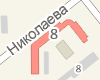 |
Institute of Philology Nikolaeva st., 8, Novosibirsk, 630090, Russian Federation +7-383-330-15-18, ifl@philology.nsc.ru |
© Institute of Philology |