 |
|
||||||||||||
|
Institute of Philology of
the Siberian Branch of Russian Academy of Sciences |
|
||||||||||||
|
|||||||||||||


 | |
|
DOI: 10.25205/2312-6337 Roskomnadzor certificate number Эл № ФС 77-84783
| |
| Yazyki i Fol’klor Korennykh Narodov Sibiri (Languages and Folklore of Indigenous Peoples of Siberia) | |
| |
|
Article
Name: Consonant palatalization in Barabian as a reflex of the vowel palatal harmony law (based on ultrasound visualization data) Authors: T. R. Ryzhikova, K. V. Shindrova Institute of Philology SB RAS, Novosibirsk, Russia In the section Фонетика
Abstract: Issues of palatality and palatalization continue to be the subject of scholarly debate, particularly considering recent advances in experimental phonetic methods and instrumentation. For Turkic languages with a stable system of palatal vowel harmony, both the theoretical interpretation and the empirical description of palatalization are of particular importance. This article investigates the mechanisms by which the acoustic effect of consonantal softness is achieved in Barabian, a Turkic language of Siberia, using ultrasound tongue imaging. Forty-five stimuli containing target consonants in various positional contexts were recorded using an ultrasound helmet and an electroglottograph from seven speakers of Barabian. Data from three speakers were statistically processed using R software. Ultrasound images are presented with the tongue tip oriented to the left. The results demonstrate that the most powerful palatalizing trigger for coronal and dorsal consonants is the high front vowel [i], which induces raising and anterior displacement of the tongue body regardless of whether the vowel occurs in a pre- or post-consonant position. This effect is especially evident in the palatalization of consonants such as /s/, /’s/, /l/, and /r/ in words exhibiting soft vowel harmony. When influenced by a palatalizing vowel, dorsal consonants exhibit a shift in their place of articulation toward the region associated with palatal and palato-alveolar consonants. The issue of auslaut consonant palatalization remains unresolved and opens new opportunities for discussion. Although ultrasound data provide substantial insight into articulatory processes, this method has inherent limitations, and the present findings require verification using complementary somatodynamic and acoustic experimental techniques. Keywords: palatality, palatalization, the Barabian language, consonantism, ultrasound examination, Turkic vowel harmony, coarticulation Bibliography: Akhmanova O. S. Slovar’ lingvisticheskikh terminov [Dictionary of linguistic terms]. Moscow, Sov. entsikl., 1966, 608 p. (In Russian) Bateman N. A crosslinguistic investigation of palatalization: PhD dissertation. San Diego, University of California, 2007, 527 p. Bhat D. N. S. A general study of palatalization. In Universals of human language. J. Greenberg (Ed.) Palo Alto, CA, Stanford University Press, 1978, pp. 47–92. Boyce S. E., Hamilton S. M., Rivera-Campos A. Acquiring rhoticity across languages: An ultrasound study of differentiating tongue movements. Clinical linguistics and phonetics. 2016, 30 (3–5), pp. 174–201. URL: https://doi.org/10.3109/02699206.2015.1127999 (accessed 10.07.2025). Catford J. C. Comment on “Variability in feature specifications”. In Invariance and variability in speech processing. Perkell J. S., Klatt D. H. (Eds). Hillsdale, N. J, Lawrence Erlbaum Associates, Publishers, 1986, pp. 478–479. Canalis S., Dikmen F. Turkish palatalized consonants and vowel harmony. Proceedings of the Workshop on Turkic and Languages in Contact with Turkic. 2020, vol. 5, pp. 41–55. Clements G. N., Sezer E. Vowel and consonant disharmony in Turkish. In The structure of phonological representations II. Harry van der Hulst & Norval Smith (Eds.). Dordrecht, Foris, 1982, pp. 213–255. Hume E. Front vowels, coronal consonants, and their interaction in nonlinear phonology. New York, Garland Publishing, 1994, 278 p. Kim H. A phonetically based account of phonological stop assibilation. Phonology. 2001, vol. 18, pp. 81–108. Ladefoged P. A course in phonetics. New York, Harcourt, 2005, 322 p. Lindau M. The story of /r/. In Phonetic linguistics: Essays in honor of Peter Ladefoged. Fromkin V. A. (Ed). Orlando, FA, Academic Press, 1985, pp. 157–168. Lingvisticheskiy entsiklopedicheskiy slovar’ [Linguistic encyclopedic dictionary]. Moscow, Sov. entsikl., 1990, 709 p. (In Russian) Ryzhikova T. R. Konsonantizm yazyka barabinskikh tatar: sopostavitel’no-tipologicheskiy aspekt [Consonantism of the Baraba Tatar language: comparative-typological aspect]. Novosibirsk, SB RAS, 2005, 269 p. (In Russian) Ryzhikova T. R., Timkin T. V., Dobrinina A. A. Yazychnye nosovye soglasnye altayskogo yazyka (rezul’taty elektropalatograficheskogo i ul’trazvukovogo issledovaniya) [Lingual nasal consonants of the Altai language (results of electropalatographic and ultrasound research)]. Tomsk State University Journal of Philology. 2024, no. 88, pp. 92–110. (In Russian) Selyutina I. Ya. Artikulyatornye parametry palatalizatsii v yuzhnosibirskikh tyurkskikh yazykakh [Articulatory parameters of palatalization in South Siberian Turkic languages]. In Yazyki korennykh narodov Rossii v polikul’turnom prostranstve: Sbornik materialov Vserossiyskoy nauchno-prakticheskoy konferentsii, posvyashchennoy 105-letiyu so dnya rozhdeniya E. G. Multuevoy, 90-letiyu so dnya rozhdeniya V. N. Tadykina, Gorno-Altaysk, 06–07 iyunya 2024 goda [Languages of the indigenous peoples of Russia in a multicultural space: Collection of materials of the All-Russian scientific and practical conference dedicated to the 105th anniversary of the birth of E. G. Multueva, the 90th anniversary of the birth of V. N. Tadykin, Gorno-Altaysk, June 6–7, 2024]. Gorno-Altaysk, S. S. Surazakov Research Institute of Altai Studies, 2024a, pp. 31–39. (In Russian) Selyutina I. Ya. Korrelyatsiya vokal’nykh i konsonantnykh komponentov slovoformy v tyurkskikh i mongol’skikh yazykakh [Correlation of vocal and consonant components of word form in Turkic and Mongolian languages]. Tomsk Journal of Linguistics and Anthropology. 2024b, no. 4 (46), pp. 100–111. (In Russian) Shindrova K. V. Artikulyatorno-akusticheskie kharakteristiki zvukov tipa “r” v yazyke plottdich [Articulatory and acoustic characteristics of [r] sounds in the Plautdietsch]. Tomsk Journal of Linguistics and Anthropology. 2025, no. 2 (48), pp. 76–90. (In Russian) Telfer C. S. Coronalization as assibilation: PhD dissertation. Calgary (Alberta), 2006, 155 p. Timkin T. V. Glasnye pervogo sloga surgutskogo dialekta khantyyskogo yazyka po dannym ul’trazvukovogo issledovaniya [First syllable vowels in Surgut khanty according to the ultrasonography data]. Sibirskii Filologicheskii Zhurnal [Siberian Journal of Philology]. 2022, no. 3, pp. 196–211. (In Russian) Urtegeshev N. S. Foniko-fonologicheskaya sistema shorskogo yazyka v yuzhnosibirskom tyurkskom kontekste [Phonic-phonological system of the Shor language in the South Siberian Turkic context]. Dr. philol. sci. diss. Novosibirsk, 2021, 583 p. (In Russian) Van de Velde H, van Hout R. Patterns of /r/ variation. In ’r-atics. Sociolinguistic, phonetic and phonological characteristics of /r/. Van de Velde H., van Hout R. (Eds.). Bruxelles, Université Libre de Bruxelles, 2001, vol. 4, pp. 1–10. |

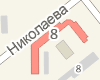 |
ИФЛ СО РАН 630090, Новосибирск, ул. Николаева, 8 тел./факс: 8-(383)330-15-18, ifl@philology.nsc.ru |
Карта сайта Дизайн © ИФЛ СО РАН |