 |
|
||||||||||||
|
Institute of Philology of
the Siberian Branch of Russian Academy of Sciences |
|
||||||||||||
|
|||||||||||||


 | |
| Sibirskii Filologicheskii Zhurnal (Siberian Journal of Philology) | |
| |
|
Article
Authors: Aziyana V. Bayyr-ool Institute of Philology of the Siberian Branch of the Russian Academy of Science, Novosibirsk, Russian Federation In the section Linguistics
Abstract: This paper examines the pragmatic functions of the Tuvan particle iyik in declarative and interrogative utterances. The study aims to identify and describe the appellative function of the particle iyik, understood as the orientation of the utterance toward the addressee and the actualization of common background knowledge shared by the participants of communication. The material comprises examples from Tuvan literary fiction and authentic colloquial speech. The structural analysis reveals that in declarative constructions, iyik serves to remind the addressee of facts already known to both interlocutors. In interrogative utterances, the particle appears in two distinct types of constructions. First, in combination with the interrogative particle be (iyikpe / iyik be), it marks a confirmation question aimed at verifying information that the speaker does not fully possess. Second, when paired with interrogative pronouns (qïm “who”, čüü “what”, qayda “where”, etc.), it signals the actualization of forgotten knowledge that the speaker previously possessed but cannot recall at the moment of speech. From the perspective of speech act theory, the study demonstrates that iyik functions as a marker of various illocutionary acts–ranging from reminding to requesting confirmation or the recovery of forgotten knowledge. The perlocutionary goal in all cases is to elicit a specific reaction from the addressee: a nod, verbal agreement, or factual information. Ultimately, the results of this study contribute to the research on the pragmatics of Turkic particles and can be utilized in the description of discourse markers in the Tuvan language. Keywords: Tuvan language, particle, pragmatics, appellative function, pragmatic function, common background knowledge, speech act theory Bibliography: Adıgüzel M. F. Semantic and pragmatic analysis of the Turkish discourse particle hele: a corpus-driven study in lexical profiling. Mersin Üniversitesi Dil ve Edebiyat Dergisi. 2015, June, vol. 12, no. 1, pp. 63–92. Adıgüzel M. F. The functional spectrum of the Turkish pragmatic marker ya. Journal of Pragmatics. 2023, vol. 213, pp. 58–71. Baranov A. N., Plungyan V. A., Rakhilina E. V. Putevoditel’ po diskursivnym slovam russkogo yazyka [Guide to discursive words of the Russian language]. Moscow, Pomovskiy i partnery, 1993, 207 p. Bayyr-ool A. V. Chastitsy tuvinskogo yazyka, obrazovannyye ot bytiynykh glagolov (v sopostavlenii s yakutskim i khakasskim yazykami) [Particles of the Tuvan language formed from existential verbs (in comparison with the Yakut and Khakas languages)]. Abstract of Cand. philol. sci. diss. Novosibirsk, 2009a, 24 p. Bayyr-ool A. V. O tematicheskoy funktsii chastitsy aan ‘to yest’, imenno’ v tuvinskom yazyke [On the thematic function of the particle aan ‘that is, exactly’ in the Tuvan language]. Kritika i Semiotika [Critique and Semiotics]. 2024, no. 1, pp. 361–371. DOI 10.25205/2307-1753-2024-1-361-371 Bayyr-ool A. V. Otglagol’naya chastitsa iyik v analiticheskikh konstruktsiyakh uslovno-soslagatel’noy semantiki v tuvinskom yazyke [The deverbal particle iyik in analytical constructions of conditional-subjunctive semantics in the Tuvan language]. Humanitarian sciences in Siberia. 2009b, no. 4, pp. 93–97. Iskhakov F. G., Pal’mbakh A. A. Grammatika tuvinskogo yazyka [Grammar of the Tuvan language]. Moscow, Vost. lit., 1961, 472 p. Kobozeva I. M. Problemy opisaniya chastits v issledovaniyakh 80-kh godov [Problems of describing particles in the studies of the 1980s]. In Pragmatika i semantika: sb. nauch.-analit. obzorov [Pragmatics and semantics: collection of scientific and analytical reviews]. Moscow, 1991, pp. 147–174. Mongush D. A. Chastitsy kak komponent analiticheskikh skazuyemykh (na materiale tuvinskogo yazyka) [Particles as a component of analytical predicates (based on the material of the Tuvan language)]. In Yazyki korennykh narodov Sibiri [Languages of the indigenous peoples of Siberia]. Novosibirsk, 1998, iss. 4, pp. 122–153. Nasilov D. M. Proshedsheye vremya na -juk / -juq v drevneuygurskom yazyke i yego refleksy v sovremennykh yazykakh [The past tense in -juk / -juq in Old Uyghur and its reflexes in modern languages]. In Tyurkologicheskiy sbornik. K shestidesyatiletiyu A. N. Kononova [Turkological collection. To the sixtieth anniversary of A. N. Kononov]. Moscow, 1966, pp. 92–104. Nikolaeva T. M. Funktsii chastits v vyskazyvanii (na materiale slavyanskikh yazykov) [Functions of particles in utterance (based on Slavic languages)]. Moscow, Nauka, 2005, 170 p. Sat Sh. Ch. Tuvinskiy yazyk (grammaticheskiy ocherk) [Tuvan language (grammatical overview)]. In Tuvinsko-russkiy slovar’ [Tuvan-Russian dictionary]. Moscow, 1955, pp. 615–721. Searle J. R. Klassifikatsiya illokutivnykh aktov [A classification of illocutionary acts]. In Novoye v zarubezhnoy lingvistike [New in foreign linguistics]. Moscow, 1986, iss. 17: Teoriya rechevykh aktov [Theory of speech acts], pp. 170–194. Shimchuk E. G., Shchur M. G. Slovar’ russkikh chastits [Dictionary of Russian particles]. V. Gladrov (Ed.). Frankfurt am Main, Berlin, Bern, Bruxelles, New York, Wien, Peter Lang – Europäischer Verlag der Wissenschaften, 1999, 146 p. Shiryaev E. N. Semantiko-sintaksicheskaya struktura razgovornogo dialoga [The semantic-syntactic structure of conversational dialogue]. Russian Language and Linguistic Theory. 2001, no. 1 (1), pp. 132–147. Starodumova E. A. Chastitsy russkogo yazyka (raznoaspektnoye opisaniye) [Particles of the Russian language (multidimensional description)]. Vladivostok, FESU, 2002, 292 p. Stolneyker R. S. Pragmatika [Pragmatics]. In Novoye v zarubezhnoy lingvistike [New in foreign linguistics]. Moscow, 1985, iss. 16: Pragmatika [Pragmatics], pp. 429–438. Tatarintsev B. I. Etimologicheskiy slovar’ tuvinskogo yazyka [Etymological dictionary of the Tuvan language]. Novosibirsk, 2002, vol. 2, 388 p. Tolkovyy slovar’ tuvinskogo yazyka [TSTYa – Explanatory dictionary of the Tuvan language]. D. A. Mongush (Ed.). Novosibirsk, Nauka, 2003, vol. 1: A–Y, 596 p. Tuvinsko-russkiy slovar’ [TRS – Tuvan-Russian dictionary]. E. R. Tenishev (Ed.). Moscow, Sov. entsikl., 1968, 646 p. Yakobson R. O. Lingvistika i poetika [Linguistics and poetics]. In Strukturalizm: “za” i “protiv” [Structuralism: “for” and “against”]. Moscow, Progress, 1975, pp. 193–230. Yakubinskiy L. P. O dialogicheskoy rechi [On dialogic speech]. Russkaya rech’. 1923, no. 1, pp. 96–194. Zemskaya E. A., Kitaygorodskaya M. V., Shiryaev E. N. Russkaya razgovornaya rech’: obshchiye voprosy. Slovoobrazovaniye. Sintaksis [Russian colloquial speech: general issues. Word formation. Syntax]. Moscow, Nauka, 1981, 276 p. |


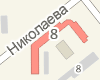 |
Institute of Philology Nikolaeva st., 8, Novosibirsk, 630090, Russian Federation +7-383-330-15-18, ifl@philology.nsc.ru |
© Institute of Philology |