 |
|
||||||||||||
|
Institute of Philology of
the Siberian Branch of Russian Academy of Sciences |
|
||||||||||||
|
|||||||||||||


 | |
| Sibirskii Filologicheskii Zhurnal (Siberian Journal of Philology) | |
| |
|
Article
Authors: Sevinj Hasan Aliyeva Baku Slavic University, Baku, Azerbaijan In the section Study of literature
Abstract: This article offers a comparative analysis of the theoretical approaches to the concept of the symbol in literature as developed by two prominent 20th-century Russian thinkers: A. F. Losev and M. M. Bakhtin. While both scholars recognize the symbol as a complex, poly-semous construct essential to the structure of literary meaning, their methodologies and interpre-tive frameworks differ substantially, reflecting divergent philosophical foundations and aesthetic priorities. A. F. Losev interprets the symbol as a dynamic unit of meaning rooted in mythologi-cal, linguistic, and metaphysical traditions. For Losev, the symbol transcends the conventional boundaries of a formal linguistic sign, functioning as a deep ontological structure capable of manifesting inexhaustible semantic layers. He regards symbolic imagery as historically and cul-turally saturated, inherently tied to archetypal structures and philosophical categories. Converse-ly, M. M. Bakhtin approaches the symbol through the lens of dialogism and cultural semiotics. He focuses on the symbol’s relational nature, its openness to interpretation, and its capacity to reflect the dialogic interplay between author, character, and reader. In Bakhtin’s model, symbols are constantly recontextualized within historical and ideological discourses, acting as vital vehi-cles of cultural memory. The article examines the theoretical implications of both frameworks, highlighting their ongoing relevance to contemporary literary studies. By tracing the evolution and functions of symbolic meaning across different cultural and narrative contexts, this study contributes to a deeper understanding of symbolic representation as a core mechanism in literary and aesthetic communication. Keywords: symbol, myth, M. M. Bakhtin, A. F. Losev, polysemy, literary theory Bibliography: Bakhtin M. M. Avtor i ego geroy v esteticheskoy deyatel’nosti [The author and his hero in aesthetic activity]. Moscow, Nauka, 1976, 162 p. Bakhtin M. M. Formy vremeni i khronotopa v romane. Ocherki po istoricheskoy poetike [Forms of time and chronotope in the novel. Essays on historical poetics]. In Bakhtin M. M. Literaturno-kriticheskie stat’i [Literary critical articles]. Moscow, Khudozh. lit., 1986b, pp. 120–290. Bakhtin M. M. K metodologii gumanitarnykh nauk. O simvolakh [Toward the methodology of the humanities. About symbols]. Moscow, Prosveshchenie, 1987, 314 p. Bakhtin M. M. Vremya i prostranstvo v proizvedeniyakh Gete [Time and space in the works of Goethe]. In Bakhtin M. M. Estetika slovesnogo tvorchestva. [Aesthetics of verbal creativity]. Moscow, Iskusstvo, 1986a, pp. 210–241. Losev A. F. Znak. Simvol. Mif [Sign. Symbol. Myth]. Moscow, Moscow State University Press, 1982, 480 p. Pesotskaya E. N. Germenevticheskie aspekty issledovaniya filosofii postupka v tvorchestve M. M. Bakhtina [Hermeneutic aspects of the study of the philosophy of action in the works of M. M. Bakhtin]. In M. M. Bakhtin v sovremennom mire. Materialy VI Mezhdunarodnukh saranskikh Bakhtinskikh chteniy, posvyaschennykh 120-letiyu so dnya rozhdeniya uchenogo [[M. M. Bakhtin in the modern world: Proceedings of the VI Intern. Saransk Bakhtin readings dedicated to the 120th anniversary of the scientist’s birth]. Saransk, N. P. Ogarev Mordovia State University Press, 2015, pp. 117–121. |


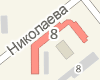 |
Institute of Philology Nikolaeva st., 8, Novosibirsk, 630090, Russian Federation +7-383-330-15-18, ifl@philology.nsc.ru |
© Institute of Philology |