 |
|
||||||||||||
|
Institute of Philology of
the Siberian Branch of Russian Academy of Sciences |
|
||||||||||||
|
|||||||||||||


 | |
| Sibirskii Filologicheskii Zhurnal (Siberian Journal of Philology) | |
| |
|
Article
Authors: Ivan O. Volkov, Emma M. Zhilyakova Tomsk State University, Tomsk, Russian Federation In the section Study of literature
Abstract: This article examines the reception of Don Quixote in Ivan Turgenev’s short prose and the role of the paired-image principle in shaping his artistic system. The focus is on the transformation of the Cervantine “double image” (Don Quixote and Sancho Panza) within nineteenth-century Russian literature. The analysis draws on Turgenev’s works, including Khor and Kalinych, Two Landowners, Chertopkhanov and Nedopyuskin, Two Friends, and Punin and Baburin. Here, character pairing recurs consistently, serving compositional and philosophical functions by expressing human duality, the interaction of idealistic and practical elements, and their necessary unity. Whereas Cervantes’ paired images generate a holistic, multilayered picture of national life and preserve internal dynamic harmony, Turgenev’s model undergoes a significant transformation. Within nineteenth-century Russian reality, the unity of opposites is disrupted: the ideal loses its transformative power, while the practical principle is deprived of moral content, resulting in the disintegration of the holistic personality. Unlike Cervantes’ broad epic narrative, Turgenev’s short prose focuses on local “moments of life,” revealing the inner structure of human existence. This shift transfers the tragedy from external action to inner reflection, registering the crisis of the humanistic ideal as a defining condition of the era. Thus, Turgenev’s engagement with the Cervantine tradition represents a profound artistic dialogue in which the classical model of paired images is not merely reproduced but reinterpreted in accordance with new historical and cultural conditions. Short prose emerges as the optimal form to expose the dramatic loss of human wholeness in the nineteenth-century world. Keywords: Ivan Turgenev, Miguel de Cervantes, Don Quixote, short prose, paired images, duality principle, poetics Bibliography: Bagno V. E. “Don Kikhot” Servantesa i russkaya realisticheskaya proza [Cervantes’ Don Quixote and Russian realist prose]. In Epokha realizma: iz istorii mezhdunarodnykh svyazey russkoy literatury [The epoch of realism: from the history of international literary relations]. Leningrad, Nauka, 1982, pp. 5–67. Bagno V. E. Dorogami “Don Kikhota”: sud’ba romana Servantesa [Along the roads of Don Quixote: the fate of Cervantes’ novel]. Moscow, Kniga, 1988, 448 p. Belinskiy V. G. Poln. sobr. soch.: v 13 t. [Complete works: in 13 vols.]. Moscow, AN SSSR, 1956, vol. 10, 474 p. Budanova N. F. Roman “Nov’” v svete turgenevskoy kontseptsii Gamleta i Don-Kikhota [The novel Virgin Soil in the light of Turgenev’s concept of Hamlet and Don Quixote]. Russkaya literatura. 1969, no. 2, pp. 180–190. Chekalov I. I. Gamlet, Don Kikhot i Nezhdanov v romane I. S. Turgeneva “Nov’” [Hamlet, Don Quixote and Nezhdanov in Turgenev’s Virgin Soil]. Atlantika. Zapiski po istoricheskoy poetike. Moscow, 2017, iss. 14, pp. 4–28. Efimchik S. M. “Gamlet” i “Don Kikhot” kak smysloporozhdayushchie struktury v tvorchestve I. S. Turgeneva [“Hamlet” and “Don Quixote” as meaning-generating structures in Turgenev’s works]. In Vstrechi i dialogi v smyslovom pole kul’tury [Encounters and dialogues in the semantic field of culture]. Omsk, 2011, pp. 193–201. Geyne G. Sobr. soch.: v 10 t. [Collected works: in 10 vols.]. Moscow, Khudozh. Lit., 1958, vol. 7, 510 p. Lyubimova E. N. Servantes i Turgenev [Cervantes and Turgenev]. In Servantes i vsemirnaya literatura [Cervantes and world literature]. Moscow, Nauka, 1969, pp. 181–196. Mikhaylovskiy N. M. Literaturnye i zhurnal’nye zametki [Literary and journal notes]. Otechestvennye zapiski. 1874, no. 4, pp. 403–408. Pinskiy L. E. Realizm epokhi Vozrozhdeniya [Realism of the Renaissance]. Moscow, St. Petersburg, Tsentr gumanitarnykh initsiativ, 2015, 320 p. Prokshin V. G. Kontseptsiya cheloveka v stat’e “Gamlet i Don-Kikhot” i ee razvitie v khudozhestvennom tvorchestve I. S. Turgeneva [The concept of man in “Hamlet and Don Quixote” and its development in the artistic work of I. S. Turgenev]. In Traditsii i novatorstvo [Tradition and innovation]. Ufa, 1975, iss. 3, pp. 166–181. Shatalov S. E. Khudozhestvennyy mir I. S. Turgeneva [The artistic world of I. S. Turgenev]. Moscow, Nauka, 1973, 312 p. Sinyakova L. N. “Oneginskiy” syuzhet v syuzhetnoy strukture povesti I. S. Turgeneva “Dva priyatelya”: kul’turno-antropologicheskiy aspekt [The “Onegin” plot in the plot structure of I. S. Turgenev’s story “Two Friends”: cultural-anthropological aspect]. Sibirskii Filologicheskii Zhurnal [Siberian Journal of Philology]. 2011, no. 3, pp. 83–89. Volkov I. O. Pis’mo V. P. Titova k V. F. Odoevskomu kak neizvestnyy otklik na stat’yu I. S. Turgeneva “Gamlet i Don-Kikhot” (k voprosu o vospriyatii turgenevskoy traktovki obraza Gamleta sovremennikami) [V. P. Titov’s letter to V. F. Odoevsky as an unknown response to Turgenev’s “Hamlet and Don Quixote” (to the question of the perception of Turgenev’s interpretation of Hamlet’s image by contemporaries)]. Tekst. Kniga. Knigoizdanie [Text. Book. Publishing]. 2021, no. 26, pp. 104–116. Volkov I. O. Uil’yam Shekspir v khudozhestvennom mire I. S. Turgeneva: “Gamlet” i “Korol’ Lir” [William Shakespeare in Turgenev’s artistic world: Hamlet and King Lear]. Moscow, LRC Publishing House, 2022, 378 p. |


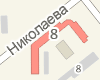 |
Institute of Philology Nikolaeva st., 8, Novosibirsk, 630090, Russian Federation +7-383-330-15-18, ifl@philology.nsc.ru |
© Institute of Philology |