 |
|
||||||||||||
|
Institute of Philology of
the Siberian Branch of Russian Academy of Sciences |
|
||||||||||||
|
|||||||||||||


 | |
DOI: 10.25205/2307-1737 Roskomnadzor certificate number Эл № ФС 77-84784 | |
| Kritika i Semiotika (Critique and Semiotics) | |
| |
|
Article
Authors: Daria N. Borovinskaya, Valeriy A. Surovtsev, Alexey N. Kozlov Surgut State Pedagogical University, Surgut, Russian Federation; Tomsk State University, Tomsk, Russian Federation
Abstract: In the introduction, the authors define the article’s relevance and purpose and formulate the research problem. The novelty of this work lies in the systematic comparison of several logical modes (formal, intuitionistic, non-monotonic, and probabilistic logic) as applied to a single object — the concept of “creative product”. The practical significance of this work lies in the potential use of the findings in refining normative and managerial definitions of creativity, in developing educational programs (competencies focused on consciously working with forms of knowledge), and in designing artificial intelligence systems capable of deep reasoning — creative products and scenarios for their creation and use. The work advances the thesis that a formal-logical approach to the study of thinking specifically facilitates the reconstruction of universal characteristics of thinking as a source of knowledge, common to both humans and artificial intelligence. Thinking is viewed as the activity of manipulating signs, organized in stable forms of knowledge — concepts, judgments, and inferences. It demonstrates how forms (the structure of concepts, judgments, and inferences) define the framework for possible contents. The conclusion highlights the usefulness of distinguishing between the form and content of knowledge for harmonizing interdisciplinary interpretations of creative products and analyzing the generative potential of humans and artificial intelligence. Keywords: thinking, form of knowledge, content of knowledge, creative product, formal-logical approach Bibliography: Brouwer L. E. J. Matematika, nauka i yazyk. Osnovaniya matematiki [Mathematics, science, and language. The foundations of mathematics]. Moscow, Nauka, 1971. Pp. 94–110. (in Russ.) Caves R. Creative industries. Cambridge, Harvard University Press, 2000. 464 р. Frege G. Begriffsschrift, a formula language, modeled upon that of arithmetic, for pure thought. In: Frege and Gödel: two fundamental texts in mathematical logic. Ed. by Jean van Heijenoort. Cambridge, MA; London, Harvard University Press, 1970. 116 p. Pp. 1–82. URL: http://dec59.ruk.cuni.cz/~kolmanv/Begriffsschrift.pdf (accessed 15.05.2026). Guide on surveying the economic contribution of the copyright industries. Rev. ed. Geneva, World Intellectual Property Organization, 2015. URL: https://www.wipo.int/edocs/pubdocs/en/copyright/893/wipo_pub_893.pdf (accessed 10.02.2026). Jaynes E. T. Probability theory: the logic of science. St. Louis, MO, 1995. 650 p. Khezmondalsh D. Kul’turnye industrii [Cultural industries]. Per. s angl. I. Kushnarevoi; pod nauch. red. A. Mikhalevoi; Vyssh. shkola ekonomiki. Moscow, Izd. dom Vysshei shkoly ekonomiki, 2014. 456 p. (in Russ.) Kripke S. A. Semantical analysis of Modal Logic I. Zeitschrift für mathematische Logik und Grundlagen der Mathematik, 1963, Bd. 9, S. 67–96. URL: https://www.fitelson.org/142/kripke_1.pdf (accessed 02.02.2026). Kuhn T. The structure of scientific revolutions. With an introductory essay by Ian Hacking. 4th ed. Chicago and London, The University of Chicago Press, 2012. 237 p. McCarthy J. Applications of circumscription to formalizing common-sense knowledge. Artificial Intelligence, 1986, no. 28, pp. 89–116. O razvitii kreativnykh (tvorcheskikh) industrii v Rossiiskoi Federatsii: Feder-al’nyi zakon no. 474016-8; Glava 1: Obshchie polozheniya [On the development of creative industries in the Russian Federation: Federal Law no. 474016-8; Chapter 1: General provisions]. In: Sistema obespecheniya zakonodatel’noi deyatel’nosti [Legislative support system]. URL: https://sozd.duma.gov.ru/bill/474016-8 (accessed 09.02.2026). (in Russ.) Prior A. N. Papers on time and tense. Oxford University Press, 1968. URL: https://plato.stanford.edu/archives/win2011/entries/prior/ (accessed 26.01.2026). Reiter R. A logic for default reasoning. Artificial Intelligence, 1980, no. 13, pp. 81–132. Surovtsev V. A. SINN i LEKTON: logiko-semanticheskie kontseptsii G. Frege i stoikov [SINN and LEKTON: logical-semantic concepts of G. Frege and the Stoics]. Moscow, Kanon+, ROOI “Reabilitatsiya,” 2026. 288 p. (in Russ.) Troelstra A. S. The scientific work of A. Heyting. Compositio Mathematica, 1968, tome 20, pp. 3–12. UK Parliament. House of Commons Library. Creative industries, 2025. URL: https://commonslibrary.parliament.uk/research-briefings/cdp-2025-0017/ (accessed 10.02.2026). |

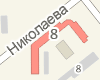 |
Institute of Philology Nikolaeva st., 8, Novosibirsk, 630090, Russian Federation +7-383-330-15-18, ifl@philology.nsc.ru |
© Institute of Philology |