 |
|
||||||||||||
|
Institute of Philology of
the Siberian Branch of Russian Academy of Sciences |
|
||||||||||||
|
|||||||||||||


 | |
DOI: 10.25205/2307-1737 Roskomnadzor certificate number Эл № ФС 77-84784 | |
| Kritika i Semiotika (Critique and Semiotics) | |
| |
|
Article
Authors: Tatiana A. Tripolskaya, Huang Xiaoyu Novosibirsk State Pedagogical University, Novosibirsk, Russian Federation
Abstract: The author of the memoir text is investigated concerning her emotional and evaluative activity within linguistic personality theory based upon the integrity of scientific knowledge, dialogism, and comparativism. Emotive and evaluative discourse integrated into the text “I, Maya Plisetskaya” allows us to reveal multifaceted description of a speaking individual forming her lexicon, world view, and communication techniques and strategies being influenced by axiological vocabulary of the epoch, area of her activity, her education, cultural level, character, and her language taste. Research of emotive and evaluative discourse gives an opportunity to simulate an integral figure of a speaking individual and to analyze individual and group language variations. The research allowed us to reveal the following characteristics of the linguistic individual: invariability of axiological world view and lexical ways of its representation throughout the whole life; intensity and all-or-nothing axiological semantics; black-and-white evaluative scale within the system of values which scarcely admits halftones. Emotive and evaluative lexicon represents the main conceptual domains of the author’s world view: talent/creativity/theater and independence / rebelliousness / love of freedom of a person in the world which lacks freedom. The main author’s technique in forming her vocabulary is reinterpreting and redirecting negative evaluations of ‘enemies of the people’ commonly mentioned in newspapers towards the representatives of the totalitarian regime. The memoir text portrays the author’s and the addressee’s images and searching of the author’s own word and her own way of getting an opportunity of being heard: the author chooses special strategies and tactics for presenting her axiological points (direct and indirect evaluative actions which are supposed to confirm, temper, and foreground certain emotive and evaluative content). Keywords: anthropocentric branch of linguistics, linguistic identity, emotive and evaluative dis-course, axiological world view, communicative techniques and strategies of expressing evaluation and self-evaluation Bibliography: Bulygina E. Yu., Tripol’skaya T. A. Nacional’no-kul’turnyj komponent v semantike metafory (na materiale gruppy «bezvol’nyj, beskharakternyj chelovek») [The national-cultural component in the semantics of metaphor (based on the group “weak-willed, spineless person”)]. Kritika i Semiotika [Critique and Semiotics], 2023, no. 1, pp. 11–27. DOI 10.25205/2307-1753-2023-1-11-27. (in Russ.) Chelovecheskij faktor v yazyke: Kommunikaciya, modal’nost’, dejksis [The human factor in language. Communication, modality, deixis]. Ed. by T. V. Bulygina. Moscow, Nauka, 1992. 280, [1] p. (in Russ.) Dementyev V. V. Nepryamaya kommunikaciya v russkoj nacional’no-reche¬voj kul’ture. [Indirect communication in the Russian national speech culture]. Vestnik RUDN. Seriia Lingvistika, 2018, vol. 22 (4), pp. 919–944. (in Russ.) Dubichynskyi V. V., Reuther T. Russko-nemeckij slovar’ leksicheskih parallelej : ok. 1750 slov. st. [Russian-German dictionary of lexical parallels: about 1750 dict. entires]. Moscow, ELPIS, 2011. 289, [15] p. URL: https://djvu.online/file/F98qu8IMcPaCC (accessed 02.05.2026). (in Russ.) Il’in I. P. Poststrukturalizm. Dekonstruktivizm. Postmodernizm [Post-structuralism. Deconstructivism. Postmodernism]. Moscow, Intrada, 1996. 253, [2] p. URL: https://djvu.online/file/K2PPjaVDnzZrP (accessed 02.05.2026). (in Russ.) Kubryakova E. S. Evolyuciya lingvisticheskij idej vo vtoroj polovine XX veka (opyt paradigmal’nogo analiza) [Evolution of linguistic ideas in the second half of the twentieth century (an attempt at paradigmatic analysis)]. In: Yazyk i nauka konca 20 veka [Language and science of the late 20th century]. Ed. by Yu. S. Stepanov. Moscow, Izd. centr RGGU, 1995. 420 p. (in Russ.) Lyapon M. V. «Grammatika» samoocenki [The “grammar” of self-esteem]. In: Russkij yazyk. Problemy grammaticheskoj semantiki i ocenochnye faktory v yazyke. Vinogradovskie chteniya XIX–XX [The Russian language. Problems of grammatical semantics and evaluative factors in language. Vinogradov readings XIX–XX]. Moscow, Nauka, 1992. Pp. 75–89. (in Russ.) Ruzhitskiy I. V. O nekotoryh istokah vozniknoveniya koncepcii yazykovoj lichnosti Yu. N. Karaulova [Some origins of the linguistic identity concept by Yuri N. Karaulov]. In: Yazykovaya lichnost’ v zerkale interpretacionnyh issledovanij: K 85-letiyu so dnya rozhdeniya Yu. N. Karaulova [Linguistic identity in interpretive research: To the 85th anniversary of Yu. N. Karaulov]. Novosibirsk, NGPU Publ., 2021. Pp. 19–28. (in Russ.) Sternin I. A. Kontrastivnye issledovaniya i kontrastivnye slovari [Contrastive studies and contrastive dictionaries]. Voronezh, VGU Publ., 2007. URL: http://homepages.tversu.ru/~ips/JubStern.html (дата обращения: 02.05.2026). (in Russ.) Tripol’skaya T. A. Yazykovaya lichnost’ K. I. Chukovskogo: modelirovanie emocional’no-ocenochnoj kartiny mira [Language personality of Korney Chukovsky: the emotive-evaluative worldview modelling]. Voprosy psikholingvistiki [Issues of Psycholinguistics], 2015, no 25, pp. 205–217. (in Russ.) Vinokur T. G. K kharakteristike govoryashhego: intenciya i reakciya [Towards characterizing the speaker: intention and reaction]. In: Yazyk i lichnost’ [Language and personality]. Ed. by D. N. Shmelev. Moscow, Nauka, 1989. 216 p. Pp. 11–23. URL: https://www.academia.edu/50183882/Язык_и_личность_Сборник_статей (accessed 02.05.2026). (in Russ.) |

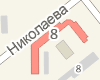 |
Institute of Philology Nikolaeva st., 8, Novosibirsk, 630090, Russian Federation +7-383-330-15-18, ifl@philology.nsc.ru |
© Institute of Philology |