 |
|
||||||||||||
|
Institute of Philology of
the Siberian Branch of Russian Academy of Sciences |
|
||||||||||||
|
|||||||||||||


 | |
DOI: 10.25205/2307-1737 Roskomnadzor certificate number Эл № ФС 77-84784 | |
| Kritika i Semiotika (Critique and Semiotics) | |
| |
|
Article
Authors: Elena G. Basalaeva Novosibirsk State Pedagogical University, Novosibirsk, Russian Federation
Abstract: The article is devoted to the study of the current state of the group of nominationsof subjects of olfactory perception, represented by a wide range of usual and occasional lexemes, such as aromamarketer, aromastylist, perfumer, flavorist, smeller, and many others. The study of the mechanisms and strategies of naming a person who perceives a smell in semantic and pragmatic aspects allows us to identify socially significant and culturally conditioned information that is important for understanding the mental models and value orientations of the creators and users of these names. The identified lexemes differ in semantic, word-formation, and function-al-stylistic aspects, which is why their frequency and spheres of use vary (from nar-rowly terminological to colloquial). In addition, many words are polysemous, which allows us to talk about discursive variation of meaning. The author notes that the subject of perception is characterized in terms of perceptual action and perceptual ability, and in many cases, the semantics of person names retain the seme of the voluntariness of perceptual action, although the action of smelling can occur involuntarily. Special attention is paid to the impact of the COVID-19 pandemic on the development of the nomination of individuals char-acterized by the presence or absence of the ability to perceive odors (“smellers” and “non-smellers”). There is a tendency to expand the conceptual framework of olfactory perception to include areas of spiritual and moral assessment of individuals. Keywords: perceptual linguistics, smell, vocabulary of olfactory perception, olfactory, the subject of olfactory perception Bibliography: Avdevnina O. Yu. Kognitivnyye i lingvisticheskiye kharakteristiki naime-novaniy litsa po pertseptivnomu deystviyu [Cognitive and linguistic characteristics of naming a person by a perceptive action]. Izvestiya of Saratov University. Philology. Journalism, 2013, no. 1, pp. 3–10. (in Russ.) Avdevnina O. Yu. Ponyatiye sub’yekt vospriyatiya v antropologii yazyka i teksta [The notion of subject of perception in the language and text anthropology]. Izvestiya of Saratov University. Novaya seriya. Seriya: Filologiya. Zhurnalistika, 2011a, vol. 11, no. 2, pp. 7–16. (in Russ.) Avdevnina O. Yu. Slepyye i zryachiye, ili zakonomernosti yazykovoy kontseptualizatsii sposobnosti/nesposobnosti k vospriyatiyu [Blind and sighted, or the regularities of the linguistic conception of the ability/inability of perception]. World of the Russian Word, 2011b, no. 1, pp. 23–30. (in Russ.) Avdevnina O. Yu. Sotsial’nyye aspekty deystvitel’nosti v semantike vospriyatiya [Social aspects of reality regarded in the light of the semantics of perception]. Pushkin Leningrad State University Journal, 2011c, no. 2, pp. 128–137. (in Russ.) Khall’shtayn A. V. Predstavleniye ol’faktornogo prostranstva v yazykovoy kartine mira novoangliyskogo perioda [Representation of the olfactory space in the language picture of the world of the New English Period]. Cand. of Sci. (Philol.) diss. Saint Petersburg, 2015. 179 p. (in Russ.) Kolesov I. Yu. O yazykovom modelirovanii znaniya o zritel’nom vospriyatii [On lingual construal of the knowledge of vision]. Vestnik KemGU, 2013, no. 2 (54), vol. 2, pp. 81–86. (in Russ.) Kustova G. O tipakh proizvodnykh znacheniy s eksperiyentsial’noy semantikoy [On the types of derived meanings of words with experiential semantics]. Voprosy yazykoznaniya, 2002, no. 2, pp. 16–34. (in Russ.) Paducheva E. V. Nablyudatel’ kak Eksperiyent «za kadrom» [The Observer as an “out-of-camera” Experiencer]. In: Slovo v tekste i v slovare: sb. st. k semidesyatiletiyu akademika Yu. D. Apresyana [The word in text and dictionary]. Moscow, Yazyki russkoy kul’tury, 2000. 647 p. Pp. 185–201. (in Russ.) Pelosi P. Obonyaniye: uvlekatel’noye pogruzheniye v nauku o zapakhakh [On the scent: a journey through the science of smell]. Moscow, KoLibri, Azbu-ka-Attikus, 2020. 304 p. (in Russ.) Verkhoturova T. L. Faktor nablyudatelya v yazyke nauki [The observer factor in the language of science]. Irkutsk, IGLU, 2008. 289 p. (in Russ.) |

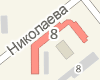 |
Institute of Philology Nikolaeva st., 8, Novosibirsk, 630090, Russian Federation +7-383-330-15-18, ifl@philology.nsc.ru |
© Institute of Philology |